Get Back to Mess
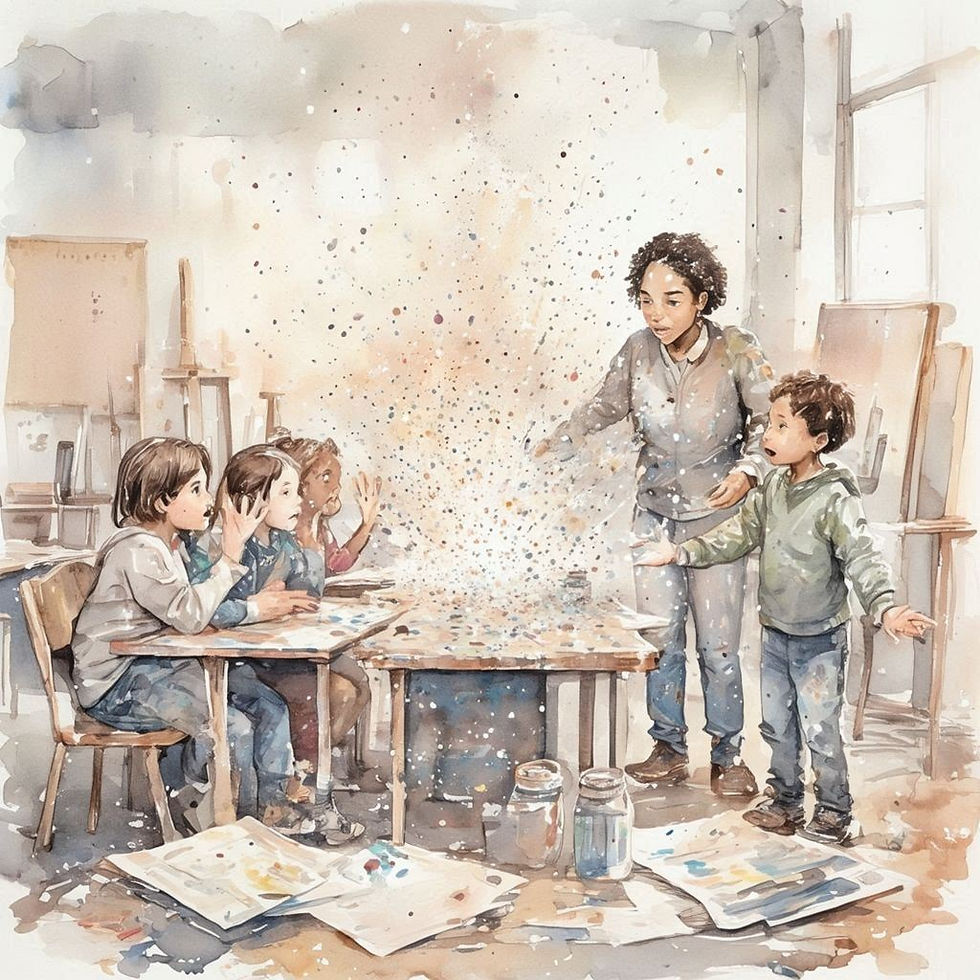
Glitter.
Say the word out loud and watch what happens.
People flinch. They laugh nervously. They immediately picture the aftermath instead of the moment.
Flour.
Put it in the hands of a child, or even a teenager, and suddenly the kitchen is alive. Hands move, laughter builds, and yes, flour flies. Counters are dusted. Floors are coated. The experience expands beyond the recipe, becoming something shared, remembered, and deeply human.
Somewhere along the way, we began to equate mess with mismanagement.
We started to believe that learning should look controlled, contained, and quiet.
Real exploration has never worked that way.
The most meaningful learning is rarely neat. It spills over. It disrupts. It creates friction. It asks questions that do not have immediate answers. It invites risk. It requires time, space, and a tolerance for not knowing exactly what the end will look like.
In classrooms, in leadership, and in life, we often clean up too quickly.
We rush to structure before curiosity has had time to breathe.
When we avoid the mess, we avoid the very conditions where discovery happens.
Mess is where thinking becomes visible.
Mess is where ideas collide and evolve.
Mess is where learners take ownership because the path is not pre-scripted for them.
The glitter is not the problem.
The flour is not the problem.
Our discomfort with unpredictability is.
Growth does not begin with answers. It begins with reflection that is honest and sometimes uncomfortable.
Where in my classroom or leadership do I prioritize control over exploration?
When learning becomes unpredictable, do I lean in or shut it down?
What does “productive mess” actually look like in my context, and am I able to recognize it?
How often do I step in too quickly to fix, organize, or redirect instead of letting learners wrestle with ideas?
Am I equating quiet with engagement and compliance with understanding?
Where might I be unintentionally signaling that the process matters less than the product?
How do I respond emotionally when things feel unstructured or incomplete?
What would happen if I allowed learning to remain unresolved for a little longer?
Shifting toward embracing mess is not about abandoning structure. It is about redefining what meaningful structure actually supports.
Redesign one learning experience this week to include open-ended exploration where the outcome is not fully predetermined.
Name the mess for students. Tell them that confusion, iteration, and revision are expected parts of the process.
Create space before closure. Resist summarizing too quickly. Let students sit in their thinking and make meaning for themselves.
Observe without intervening. Choose a moment to step back and watch how students navigate challenges without immediate guidance.
Celebrate process over polish. Highlight effort, risk-taking, and thinking instead of only finished products.
Build reflection into the mess. Ask students to articulate what they are discovering while they are still in the middle of it.
Shift your language. Replace “fix it” with “tell me what you’re noticing.”
Normalize revision. Make it clear that first attempts are meant to be incomplete and evolving.
Examine your environment. Does your space allow for movement, collaboration, and visible thinking, or does it demand stillness and perfection?
Model your own mess. Think out loud. Show uncertainty. Demonstrate how you navigate not knowing.
Mess is not the absence of learning.
It is evidence that learning is alive.
The classroom that looks perfectly ordered at all times may feel efficient, but it often lacks depth.
The classroom that breathes, shifts, and sometimes spills over is where learners begin to see themselves as thinkers, creators, and problem-solvers.
Flour on the counter means something was made.
Glitter on the floor means something was created.
Neither disappears immediately, and that is the point.
If we want students to engage deeply, to question boldly, and to build understanding that lasts, we have to stop fearing what it looks like along the way.
Get back to the mess.
That is where the real work lives.

Comments