Hold the Scaffold, Not the Pencil
One of the hardest things for a practitioner is watching someone struggle when you know exactly how to fix it.
You see the student hesitate.
You hear the silence after the question.
You watch someone start down the wrong path.
You know the answer, the next step, the better strategy.
Every instinct says: help.
That instinct comes from care.
Care, though, can quickly become rescue.
Difficulty alone does not build courage. Supported uncertainty can.
The distinction is important.
Productive struggle requires uncertainty. It asks the learner to sit in the space between what they know and what they can't yet do independently.
That space can feel uncomfortable.
It is supposed to.
Our job is not always to make the discomfort disappear.
Our job is to make sure the learner has enough knowledge, structure, tools, time, and trust to remain in the struggle long enough to learn from it.
Support Is Not the Same as Saving
Practitioners often talk about scaffolding, differentiation, responsiveness, and meeting learners where they are.
All of those things matter.
The danger comes when support starts doing the thinking for the learner.
We give the next answer too quickly.
We finish the sentence.
We tell them where to look before they have had time to search.
We intervene the moment frustration appears.
We simplify the task until the thinking disappears.
Then we congratulate ourselves for helping.
The learner may have completed the task, but completion and learning are not the same thing.
A perfectly supported product can hide an underdeveloped process.
Frustration Is Not Automatically a Problem
We have become very attentive to discomfort, which is important.
Discomfort is not always evidence that something has gone wrong.
Learning often includes moments of uncertainty, confusion, revision, persistence, and even frustration.
The question for the practitioner is not:
How do I make this easier?
A better question is:
What does this learner need in order to keep thinking?
That small shift changes everything.
Maybe they need more time.
Maybe they need the directions clarified.
Maybe they need a tool they already know how to use.
Maybe they need a question instead of an answer.
Maybe they need reassurance that being stuck is part of the work.
Maybe they need absolutely nothing from us for another thirty seconds.
That last one can be the hardest.
Wait Time Is an Instructional Move
Silence can make adults uncomfortable.
A student pauses, and we fill the space.
A group struggles, and we redirect.
Someone says, “I don’t know,” and we begin feeding clues almost immediately.
The ability to wait is one of the most underappreciated instructional skills.
Waiting communicates:
I believe you can think about this.
I am not interpreting your hesitation as incapacity.
I am here if you need me.
I am not going to steal the thinking from you.
Productive struggle depends on that kind of restraint.
The Goal Is Not Struggle for Struggle’s Sake
There is an important boundary here.
Throwing someone into a task they are not prepared for is not rigor.
Withholding necessary instruction is not independence.
Watching someone fail repeatedly without intervention is not productive struggle.
Supported uncertainty requires professional judgment.
The learner must have a reasonable pathway forward.
The task should sit close enough to current understanding that effort, strategy, feedback, and persistence can move the learner ahead.
The practitioner remains present.
We simply resist becoming the solution.
Productive struggle often requires us to examine our own discomfort as much as the learner’s. Before stepping in, ask yourself:
Am I helping because the learner needs support, or because I am uncomfortable watching the struggle?
Have I given enough time before intervening?
Is my support preserving the thinking or replacing it?
Could I respond with a question instead of an answer?
Does this learner already have a strategy or tool they could use?
Is the task appropriately challenging, or have I asked for something they were never prepared to do?
Am I rewarding speed when persistence would be more valuable?
Do my learners believe that “I don’t know yet” is an acceptable place to begin?
What would happen if I waited thirty more seconds?
Protecting productive struggle requires deliberate practice from the practitioner. Small changes in our responses can create much more room for learners to think.
Pause before helping.
Build a deliberate wait into your practice. Give the learner enough time to process before interpreting silence as a request for rescue.
Ask, “What have you tried?”
This keeps ownership with the learner and reveals the thinking already underway.
Offer the smallest useful support.
Give just enough information to restart thinking, not enough to finish the task.
Point back to available tools.
Instead of solving the problem, remind learners what resources, strategies, models, notes, peers, or prior learning they can access.
Use questions that move thinking forward.
Try: “What do you notice?” “What part makes sense?” “Where did you get stuck?” “What could you try next?”
Normalize being stuck.
Treat uncertainty as part of learning, not evidence of failure.
Fade support intentionally.
If learners always receive the same level of assistance, support becomes dependency. Gradually remove prompts as competence develops.
Reflect on who gets rescued most often.
Pay attention to patterns. Our assumptions about who can tolerate challenge may quietly shape who gets the opportunity to develop independence.
The Fundamental Idea
Good practitioners care deeply about the people in front of them.
That care can make it difficult to resist stepping in.
Real support is not measured by how quickly we remove the difficulty.
It is measured by how thoughtfully we create the conditions for someone to work through it.
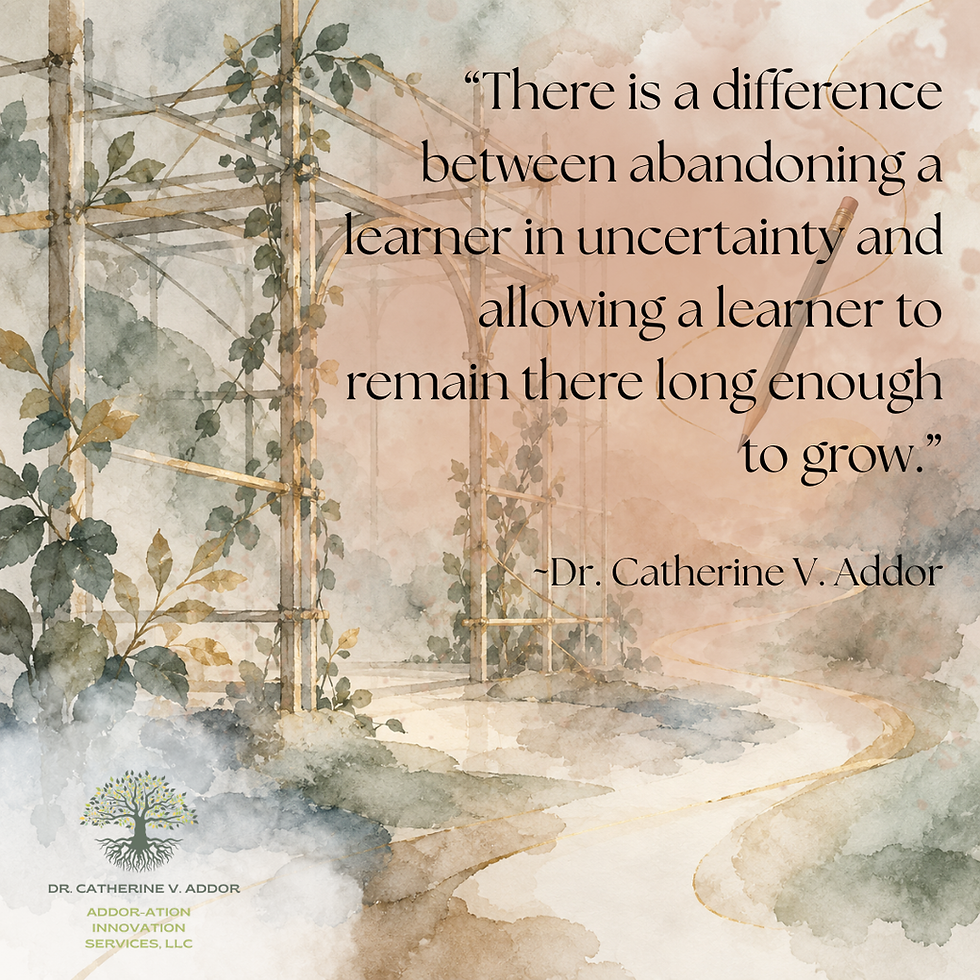
There is a difference between abandoning a learner in uncertainty and letting a learner stay there long enough to grow.
The practitioner stays close.
The tools are available.
The task is reachable.
The learner still has to do the thinking.
That is where confidence develops.
That is where independence begins.
That is where someone learns, not simply that they can complete the work, but that they can encounter something they do not immediately know how to do and stay with it.
Difficulty alone does not build courage. Supported uncertainty can.



Comments